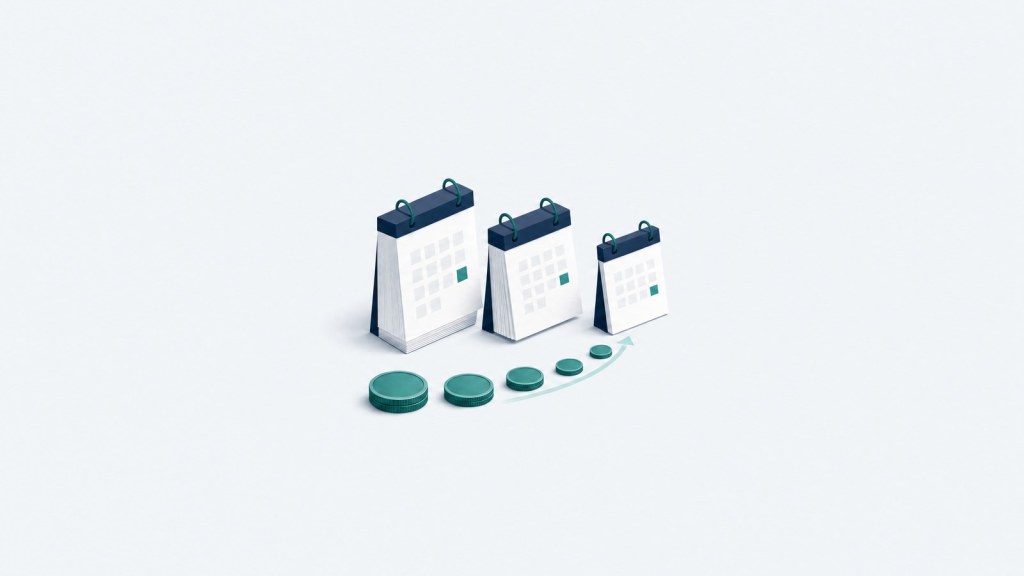
Your payment terms decide how long your money sits in your customers’ bank accounts instead of yours. Choose terms that are too long and you fund your customers’ working capital. Choose terms that are too short and you may lose business to competitors. This guide walks through how to pick the right terms, and how to change them when you need to.
The basic trade-off: cash flow versus competitiveness
Every extra day of credit you give is a day you wait for cash you have already earned. Say a business invoices $100,000 a month on 30 day terms and customers pay on time. At any moment, roughly one month of sales, about $100,000, is tied up in receivables. Move the same customers to 60 day terms and that figure roughly doubles to $200,000. Move to 90 days and it is around $300,000.
That extra cash has to come from somewhere: your own reserves, an overdraft or a credit line, all of which have a cost. Longer terms also raise your risk, because the more a customer owes you, the more you lose if they fail.
On the other side, generous terms can win and keep customers. In some markets, offering shorter terms than competitors puts you at a disadvantage, especially with large buyers who expect longer terms as standard.
The right answer balances both. Start with the shortest terms your market will accept, then extend only where there is a clear commercial reason.
What is normal in your industry
Typical terms vary widely by sector and by country. Some industries work on 30 days as standard; others, such as some construction, manufacturing and large retail supply chains, commonly use longer terms. Professional services firms often invoice on 14 or 30 days, while businesses that sell to consumers may take payment upfront.
To find out what is normal in your market:
- Ask your sales team what terms competitors are offering.
- Look at the terms your own suppliers give you.
- Check what your largest customers expect, and what their own supplier terms say.
- Speak to a trade association in your sector.
Use this as a starting point, not a rule. Matching the market is sensible; matching the longest terms in the market rarely is.
Match terms to customer size and risk
You do not need to give every customer the same terms. A simple tiered approach works well:
- New or higher-risk customers: shorter terms (for example 14 or 30 days), a lower credit limit, or payment upfront until they build a track record.
- Established customers with a good payment history: your standard terms.
- Large, low-risk customers with strong buying power: longer terms if they insist, ideally in exchange for something, such as higher volumes, a longer contract or a lower dispute rate.
Base the decision on a credit check, not just on the size of the opportunity. Our guide on how to evaluate customer creditworthiness explains what to look at, and your terms should sit alongside the credit limits described in how to set credit limits for new customers.
Early payment discounts
An early payment discount rewards customers for paying sooner. The most familiar format is 2/10 net 30. It means:
- The customer can take a 2% discount if they pay within 10 days.
- Otherwise, the full amount is due within 30 days.
Here is a worked example. Say you send a $10,000 invoice on 2/10 net 30 terms. If the customer pays within 10 days, they pay $9,800. If not, they pay $10,000 by day 30.
That 2% sounds small, but you are paying it to get your money 20 days earlier. Over a full year, that is an expensive way to borrow, often far more than an overdraft or credit line would cost. Before offering a discount, compare its cost with your other sources of cash.
Discounts also bring practical problems. Some customers take the discount and still pay late. Decide in advance how you will handle that, and state it clearly in your terms. Early payment discounts work best when cash is very tight, or for a small number of customers where faster payment is worth the cost.
Deposits and stage payments
For large orders, custom work or long projects, you do not have to wait until the end to get paid.
- Deposits: ask for a percentage of the order value upfront, before work starts or goods are ordered. This covers your initial costs and tests the customer’s commitment.
- Stage payments (milestone billing): invoice at agreed points, such as on signing, on delivery of a first phase, and on completion.
- Payment on account: for ongoing work, invoice regular fixed amounts and reconcile at the end.
These options reduce how much you have at risk at any one time, and they are widely accepted in project-based industries.
Rules on maximum payment periods
In some situations, the law limits how long payment terms can be. The UK and some other jurisdictions have rules on maximum payment periods in certain contexts, such as some business-to-business contracts and contracts involving public bodies. The details differ by country and type of contract. If you are setting long terms, or a customer is pressing you to accept them, confirm what applies with a qualified adviser for your jurisdiction.
How to change terms for existing customers
Shortening terms for an existing customer needs care. Handled badly, it feels like a punishment. Handled well, it is a normal business update.
- Check your contract. Your existing agreement may set how and when terms can change. Respect any notice period.
- Give reasonable notice. Explain the change in writing and give the customer time to adjust their payment runs.
- Explain the reason simply. Rising costs, a policy review or a change in credit insurance are all reasonable explanations.
- Apply it to new invoices only. Do not change terms on invoices already issued.
- Offer a transition if needed. Stepping from 60 to 45 to 30 days over a few months can make the change easier to accept.
A short template:
Subject: Update to our payment terms
Hi [Name],
Following a review of our credit policy, we are updating our standard payment terms from 60 days to 30 days from the date of invoice. This will apply to all invoices issued from [date]. Invoices issued before then keep their current terms.
If you would like to discuss how this fits with your payment runs, please get in touch.
Kind regards,
[Your name]
Record your standard terms, and who can approve exceptions, in your credit control policy so everyone applies them consistently.
Key takeaways
- Every extra day of credit ties up cash and increases your risk, so start with the shortest terms your market accepts.
- Use industry norms as a guide, but set terms by customer risk, not just customer size.
- Early payment discounts like 2/10 net 30 speed up cash but can be costly; compare them with other sources of funding.
- Deposits and stage payments reduce exposure on large orders and long projects.
- Change terms for existing customers in writing, with notice, and only for new invoices.


Leave a Reply